
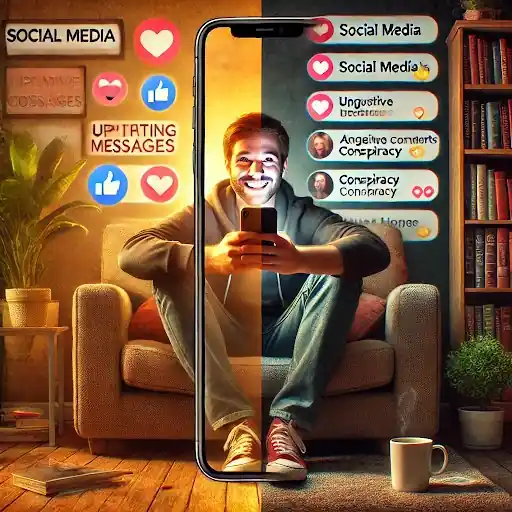
In 2023, a young man in early psychosis told me Facebook “proved” that strangers were following him. Another patient swore that her TikTok feed was sending her secret messages. These aren’t rare stories in clinical practice anymore — they’re examples of what researchers are now calling “delusion amplification” by social media.
And yet, the same platforms can also be lifelines: people with psychosis use social media to keep up with friends, find supportive groups, and push back against isolation. The past decade of research shows social media is a double-edged sword for psychosis — one that clinicians, patients, and families need to handle carefully.
What the research shows
- Heavy use is common in psychosis. Studies find that people with psychosis engage with Facebook, Instagram, and other platforms at rates comparable to — or higher than — the general population. For many, it’s one of the few consistent forms of social interaction.
- Potential benefits: Online engagement can reduce loneliness, provide access to psychoeducation, and create peer-to-peer support networks. Social media can also help people share recovery stories and reduce stigma.
- Risks for delusion-prone users: A 2025 review proposed the Delusion Amplification Model, where curated feeds, echo chambers, and anonymous interactions can reinforce unusual beliefs and distort self-image. Individuals with paranoia, grandiosity, or fragile self-concepts may be especially vulnerable.
- Indirect pathways: Cyberbullying, social comparison, and exposure to conspiracy content can all add stress — a known risk amplifier for psychotic symptoms.
Stress pathways at work
- Social comparison → low mood → symptom flare
Instagram-perfect lives can worsen self-esteem, and in psychosis, low mood often correlates with symptom intensity.
- Cyberbullying → hypervigilance
Being targeted online can heighten mistrust and feed persecutory ideas. For someone already prone to paranoia, this can be destabilizing.
- Algorithmic reinforcement → delusional validation
Social media algorithms serve more of what you engage with. If that includes suspicious or conspiratorial content, the feed may “prove” to the user that their belief is correct.
The pandemic’s role
Lockdowns pushed more social interaction online. For some patients with psychosis, this increased access to supportive spaces; for others, it meant unfiltered exposure to triggering content without the reality check of in-person contact. These patterns often persisted after restrictions were lifted — meaning post-pandemic care still has to address digital habits.
Practical recommendations (for clinicians & patients)
- Ask about online life. Include social media use in psychosocial assessments; ask what platforms they use, for how long, and in what emotional state.
- Set collaborative guidelines. Co-create limits on time, platform type, and engagement style; integrate these into relapse prevention plans.
- Curate the feed. Encourage following recovery-oriented or neutral-interest accounts, and muting/blocking harmful ones.
- Promote offline anchors. Balance online time with structured, in-person activities to ground reality testing.
- Build digital literacy. Teach patients to question sources and recognize algorithmic bias.
When to escalate
- Social media content is directly incorporated into delusions or hallucinations
- Online harassment is worsening mental state.
- Function is impaired (sleep disruption, neglecting basic needs due to online time).
The takeaway
Social media isn’t inherently “good” or “bad” for psychosis — it’s a tool that can either connect or destabilize. The difference lies in patterns, context, and vulnerabilities. By making online life part of the treatment conversation, we can help patients keep the benefits while minimizing the risks.
References (APA)
- Yang, X., & Crespi, C. (2025). Delusion amplification by social media: How digital platforms can exacerbate mentalistic delusions. Frontiers in Psychiatry, 16, 1524730. https://doi.org/10.3389/fpsyt.2025.1524730
- Birnbaum, M. L., et al. (2020). Use of social media in adolescents and young adults with psychotic disorders: A systematic review. Psychiatric Services, 71(4), 355–366. https://doi.org/10.1176/appi.ps.201900211
- World Health Organization. (2022). COVID-19 pandemic triggers 25% increase in prevalence of anxiety and depression worldwide. Retrieved from https://www.who.int/news/item/02-03-2022-covid-19-pandemic-triggers-25-increase-in-prevalence-of-anxiety-and-depression-worldwide
About the Author
Written by Kevin Caridad, PhD, CEO of Cognitive Behavior Institute and CBI Center for Education.
For speaking, training, or consultation: KevinCaridad@the-cbi.com.
Explore services: Cognitive Behavior Institute • the-cbi.com • CBI Center for Education • CenterforEducation.com