
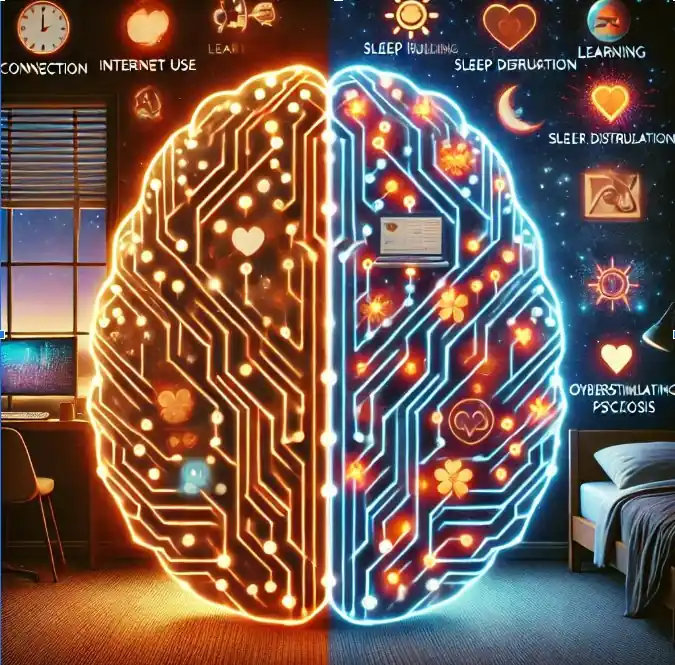
If the internet were a medication, the label would read: effective when used as directed; harmful at high doses. For most people, going online connects us to information, support, and community. But when use becomes problematic — driven by compulsion, wrecking sleep, or wrapped in toxic interactions — it correlates with higher distress and, in vulnerable people, psychosis-spectrum experience.
The past three decades of research paint a nuanced picture: the internet itself is not a villain, but how and why we use it matters.
What the Research Actually Says (1990s → Today)
- Early concerns (mid-1990s–2000s): Clinicians began describing “problematic internet use,” with symptoms resembling behavioral addictions (tolerance, withdrawal). Case reports even noted brief psychotic episodes after abrupt cessation of heavy online activity — a kind of “withdrawal psychosis.” PMCPubMed
- 2010s–2020s: Studies shifted focus from whether the internet harms to which patterns harm. Findings cluster around stress pathways — sleep loss, cyberbullying, and emotional dysregulation that can amplify psychotic-like experiences (paranoia, unusual perceptions), particularly in youth.PMC
- Bottom line: ordinary use is not consistently linked to worse symptoms; problematic use is the red flag — especially when paired with poor sleep and hostile online environments.PMC
Stress Pathways That Matter
- Sleep disruption → symptom flare: Heavy late-night online activity and gaming trash sleep. In a 2022–2023 study of university students, insomnia fully mediated the link between internet gaming disorder and paranoid ideation. Cyberbullying partly mediated the link to psychoticism — a constellation of psychosis-like traits. Translation: fix sleep and reduce exposure to online hostility, and risk markers fall.BioMed CentralPMC
- Cyberbullying and social stress → vulnerabilit: Toxic online interactions correlate with higher psychotic-spectrum scores. This does not mean “the internet causes psychosis”; it means stress load from online victimization can push vulnerable people toward symptom expression.PMC
- Withdrawal / abrupt change → destabilization: Rarely, stopping an extreme pattern of use cold-turkey precipitates brief psychosis — akin to other behavioral addictions. Clinicians have documented rapid resolution with treatment, but it is a cautionary tale: taper when reducing extreme use.PMC
Who Is Most at Risk
Youth and young adults with high time online, irregular sleep, and exposure to cyberbullying.
Individuals with existing mood or anxiety symptoms, which often co-travel with problematic online use.
People with psychosis-proneness traits (schizotypy), who may use the internet to cope — sometimes in ways that reinforce distress.
Pandemic Aftershocks You Can Still Feel
During the first pandemic year, global anxiety and depression rose about 25 percent, with youth and women hit hardest — exactly the groups most embedded online. More time at home meant more screen time and, for some, entrenched habits (late-night scrolling, gaming marathons) that still linger and still matter.
World Health OrganizationPMC
Practical Guidance (What We Recommend at CBI)
Screen the behavior, not just the hours. Red flags: loss of control, sleep loss, conflict, grades or work impairment, withdrawal symptoms. Pair with brief sleep and mood screens.
Treat sleep as a clinical target. Enforce wind-downs, blue-light limits, and consistent bedtimes; consider CBT-I principles.
De-toxic the feed. Mute or block hostile accounts; reduce exposure to conflictual forums; add prosocial communities.
Taper extreme patterns. Move from “all-night” to time-boxed sessions; schedule offline anchors such as meals, exercise, and in-person contact.
Relapse plan. If psychosis symptoms exist (or risk is high), document an early-warning plan that includes digital triggers and specific steps (contact team, reduce stimulation, sleep reset).
When to Escalate Care
New or worsening hallucinations, delusions, or severe paranoia.
No sleep for more than 48 hours or severe insomnia despite behavioral changes.
Safety risk (self-harm, harm to others) or inability to care for self.
If in crisis, call 988 (U.S.) or your local emergency number.
The Takeaway
The internet is not inherently harmful to mental health; problematic use is. Focus on sleep, stress, and moderation — and if psychosis is in the picture, make digital behavior part of the treatment plan. That is how we keep the “medicine” working while minimizing side effects.
References (APA)
- Paik, A., Oh, D., & Kim, D. (2014). A case of withdrawal psychosis from Internet addiction disorder. Psychiatry Investigation, 11(2), 207–209. https://doi.org/10.4306/pi.2014.11.2.207
- Saadi, S., et al. (2023). The relationship between internet gaming disorder and psychotic experiences: Cyberbullying and insomnia severity as mediators. BMC Psychiatry, 23, 701. https://doi.org/10.1186/s12888-023-05363-x
- World Health Organization. (2022, March 2). COVID-19 pandemic triggers 25% increase in prevalence of anxiety and depression worldwide (News release). World Health Organization.
- Santomauro, D. F., et al. (2021). Global prevalence and burden of depressive and anxiety disorders in 204 countries and territories in 2020 due to the COVID-19 pandemic. The Lancet, 398(10312), 1700–1712. https://doi.org/10.1016/S0140-6736(21)02143-7
About the Author
Written by Kevin Caridad, PhD, CEO of Cognitive Behavior Institute and CBI Center for Education.
For speaking, training, or consultation: KevinCaridad@the-cbi.com
Explore services: the-cbi.com • CBI Center for Education